Dynamometers are electromechanical instruments designed to place a controlled mechanical load on torque-producing devices such as motors. They are used to characterize motor torque as a function of speed. Bench-top dynamometers (or "dynos") are a specialized kind of instrument and are typically costly due to limited market demand. Consequently, motor designers or users who have a limited budget may not be able to afford the $10,000 commercial units, and may not be able to find a less costly unit in the used or surplus markets. The remaining alternative is to build a dyno from low-cost components.
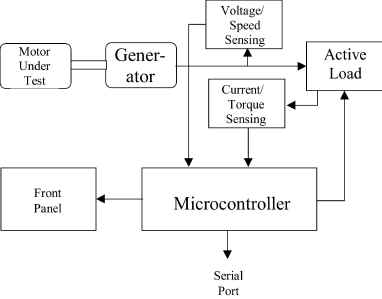
The Innovatia approach is to use a brush or PMS motor as a mechanically-driven generator, driven by the motor under test. The generator is made the active load and torque sensor instead of a hysteresis brake. The motor torque or speed is controlled by measuring either quantity and controlling the other to achieve the set value. Once the generator (which can be a brush or PMS motor) is characterized, applied torque can be measured by measuring its winding current. Speed can be sensed from the spinning shaft using an optical coupler, or from the induced-voltage waveforms of the generator itself.
The "benchtop dyno" project was begun in 1999 with the goal of developing a low-cost dynamometer for electric motor and motor-drive testing. This project continues to develop but enough has been done to sell plans. The implementation is based on the older 6502 microcomputer and the source code is provided in assembler and Forth-83. Mechanical drawings for the fixturing are included. Motor-generator and motion control theory as it applies to the dyno is explained in tutorial detail.
The project manual currently consists of a single PDF document of 90 pages. As offered, detailed circuit design for a working prototype is available but needs completion. The dyno is undergoing design refinement and is in design phase.
Contact Innovatia to join project and receive the PDF project manual for the DYN501 Benchtop Dyno.